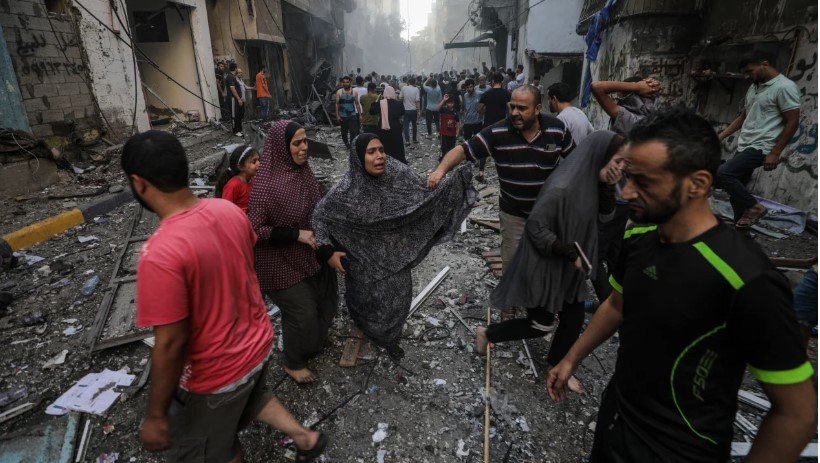
Conditions in Gaza have deteriorated into a “complete catastrophe,” according to one official, with serious shortages of clean water and food as tens of thousands of Palestinians attempt to flee crippling airstrikes and an imminent Israeli ground offensive.
Israel’s military said Saturday its forces are readying for the next stages of the war, including “combined and coordinated strikes from the air, sea and land” in response to the unprecedented October 7 terrorist attacks by the Islamist militant group Hamas, which controls the enclave.
At least 1,300 people were killed during Hamas’ rampage in what US President Joe Biden described as “the worst massacre of Jewish people since the Holocaust.”

Further escalation of the long-running conflict now increasingly risks spilling over regionally, prompting the Pentagon to order a second carrier strike group and squadrons of fighter jets to the region as a deterrence to Iran and Iranian proxies, such as Hezbollah in Lebanon.
The clock is ticking for residents fleeing south through the battered streets of Gaza after the Israeli military told civilians to leave northern areas of the densely populated strip.
More than half of Gaza’s 2 million residents live in the northern section that Israel said should evacuate. Many families, some of whom were already internally displaced, are now crammed into an even smaller portion of the 140-square-mile territory.
Civilians packed into cars, taxis, pickup trucks and donkey-pulled carts. Roads were filled with snaking lines of vehicles strapped with suitcases and mattresses. Those without other options walked, carrying what they could.
“We will commence significant military operations only once we see that civilians have left the area,” Israel Defense Forces (IDF) spokesperson Lt. Col. Jonathan Conricus told CNN early Sunday. “I cannot stress more than enough to say now is the time for Gazans to leave.”
Even as civilians fled southward, Israeli warplanes continued to blast Gaza over the weekend. Videos showed explosions and bodies along a Gaza evacuation route Friday, as tens of thousands of people abandoned their homes on the advice of the IDF.
Extensive destruction could be seen on Salah Al-Deen street – a main route for evacuation – in videos authenticated by CNN. A number of bodies, including those of children, can be seen on on a flat-bed trailer that appears to have been used to carry people away from Gaza City.
The IDF on Sunday denied that the Israeli military was involved in the strike on Salah Al-Deen street.
“It was only this morning that we were able to confirm and announce that this was not on IDF strike,” IDF spokesperson Lt. Col. Peter Lerner said in an interview with CNN. Lerner instead said it appears from footage the IDF has viewed that “the explosion came from beneath,” suggesting “some sort of explosive device.”
The Palestinian Health Ministry said 2,329 civilians have been killed and more than 9,000 injured since the conflict broke out a week ago, with 300 killed in the past 24 hours.
Casualties in Gaza over the past eight days have now surpassed the number of those killed during the 51-day Gaza-Israel conflict in 2014, according to the spokesperson for the Palestinian Health Ministry.
Richard Brennan, a World Health Organization official in Cairo, told CNN that 60% of those killed in Gaza the last week were women and children.
Several United Nations agencies have warned that mass evacuation under siege conditions will lead to disaster, and that the most vulnerable Gazans, including the sick, elderly, pregnant and disabled, will not be able to relocate at all. For days, Israel has cut off the Gaza population’s access to electricity, food and water.
“Despite Israeli announcements suggesting that there are safe areas for people trapped in the Gaza Strip, they are in fact exposed to bombardment throughout the entire territory, including in the south,” said Avril Benoit, executive director of Doctors Without Borders (MSF).
A growing number of nations, global rights groups and organizations are calling on Israel to respect international rules of war, urging the protection of civilians’ lives, and not to target hospitals, schools and clinics. Jordan’s foreign minister warned that Israel’s actions in Gaza are causing a humanitarian disaster and amount to mass punishment for more than 2 million Palestinians.
The World Food Programme (WFP) warned on Sunday that it’s running out of reserve stock inside Gaza and needs replenishment as soon as possible.
The WFP has “food for 1.3 million people for two weeks piled up at the borders into Gaza,” WFP regional director Corinne Fleischer told CNN in an interview from Cairo on Sunday, adding: “People are really getting hungry.”
Fleischer said the WFP had reached 520,000 people in Gaza so far, providing them with canned food, bread and cash to use in stores. They are expecting to reach 224,000 people on Sunday.
“We still are distributing despite the absolute chaos and our staff being themselves in shelters with no food, no mattresses, no water and no bathrooms, no electricity,” Fleischer said.
As food, clean drinking water and medical supplies in Gaza run out, there are urgent pleas for humanitarian aid to be allowed in. Footage showed aid convoys continuing to arrive into Egypt’s El-Arish stadium in preparation to enter Gaza through the Rafah land crossing. On the Gazan side, thousands of people are stuck at the crossing, with families telling CNN they have been unable to cross into Egypt.
Egyptian Foreign Minister Sameh Shoukry told CNN Saturday that Egypt has tried to ship humanitarian aid to Gaza but has not received the proper authorization to do so.
There is no more electricity and those with fuel-powered generators will soon live in complete blackout. Internet access, through which residents communicate their plight to the world, is also shrinking.
MSF’s Benoit told CNN Saturday that many people in Gaza are beginning to suffer from severe dehydration.
“Everyone there feels like they are likely to be collateral damage,” Benoit said. “The health care system there has always been extra fragile and was considered (a) humanitarian chronic emergency for many, many years, and now it’s a complete catastrophe.”
Palestine Red Crescent Society spokesperson Nebal Farsakh told CNN the situation in Gaza is “devastating” and though they had been notified by Israel to evacuate Al-Quds hospital in Gaza City, they did not have the means to do so.
“We have around 300 patients at the hospital. Some of them are in the intensive care unit. We have children in incubators. We can’t evacuate them,” Farsakh said.
The World Health Organization said Saturday it “strongly condemns Israel’s repeated orders for the evacuation of 22 hospitals” in Gaza, calling it a “death sentence for the sick and injured.”
If patients are forced to move and are cut off from life-saving medical attention while being evacuated, they all face imminent deterioration of their condition or death, the WHO said in a statement.
Health facilities in northern Gaza continue to receive an influx of injured patients and are struggling to operate beyond capacity, with some patients “being treated in corridors and outdoors in surrounding streets due to a lack of hospital beds,” it added.
Israel, which has massed troops and military equipment at the border with Gaza, said its ramped up offensive will feature hundreds of thousands of reservists and encompass “a wide range of operational offensive plans.”
In addition to widespread airstrikes, Israel’s army is preparing troops for an “expanded arena of combat,” the IDF said in a statement on Saturday. The preparations have placed “an emphasis on significant ground operations.”
Hamas has shown a level of military capability far beyond what was previously thought, and a recent CNN investigation found it is probably well-prepared for the next phase of the war.
Complicating an Israeli offensive in Gaza are up to 150 hostages captured by Hamas – including soldiers, civilians, women, children and the elderly – and who are being held in the crowded enclave.
IDF spokesperson Conricus said it is a top priority to get hostages out of Gaza, despite the difficulty that a dense urban area adds to the fight.
Pointing to the “elaborate network of tunnels” that Hamas has, he said hostages “are most likely held underground in various locations.”
“Fighting will be slow. Advances will be slow, and we will be cautious,” he said.